|
A cataract is a cloudiness or haze in the natural lens of the eye. More than 50 percent of individuals over the age of 60 will have some degree of cataract, and quite a few younger than that, especially in diabetics, following trauma, or with the use of certain prescription drugs such as prednisone. The progressive clouding of the lens causes symptoms that can interfere with your vision.
| |
 |
|
 |
|
| |
Normal Vision |
|
With Cataract |
|
Because the cloudy lens allows less light to reach the retina, distance and reading vision is often fuzzy and indistinct through the affected eye. Other symptoms of cataract include diminished color perception (especially blues and purples), annoying glare in sunlight, poor night vision, and excessive glare from oncoming headlights. Frequent changes in eyeglass prescriptions may also be a sign of cataract formation.

If you suspect a cataract, call our office to schedule a simple, painless screening exam. Fortunately, today there is a relatively straightforward procedure for the replacement to the eye's natural lens with a clear lens implant called an "intraocular" lens.
To date, there is no medical treatment to reverse or arrest cataract formation, either in oral or eyedrop medications. The only successful current treatment is surgical removal of the clouded natural lens. When the natural lens is removed, an artificial lens is inserted in its place: an intraocular lens, also known as an "IOL", or lens implant.
It is now possible to perform cataract surgery without blades using the
CATALYS Femto Second Laser system. The laser creates the necessary
incisions which previously could only be done by hand using blades.
This innovation offers a higher level of precision and safety to an
already highly successful and safe operation. Astigmatism can also be
reduced with this technology which helps to achieve the best possible
vision without glasses after surgery.
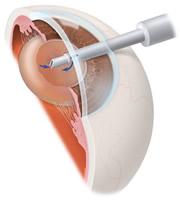
For many patients the procedure can be done using eye drops as
anesthesia referred to as “topical” anesthesia. This eliminates the
need for injections to numb the eye. Through very small incisions
the natural lens of the eye is removed by a process called
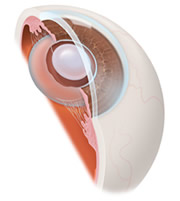
phacoemulsification. The natural lens of the eye is then replaced
with an implanted lens called an intraocular lens. The intraocular lens
literally replaces the natural lens in its position behind the pupil
opening of the eye. Although surgery time may vary, typically it takes
about 10 minutes and in the vast majority of cases no stitches are
required.
| |
 |
|
 |
|
| |
Phaco Surgery |
|
IOL in place |
|
There are 3 basic types of intraocular lenses: fixed focus, multifocal,
and toric. The fixed focus lens is used generally to provide good
distance vision without glasses and glasses are needed for reading.
This technology has been available for many years and works quite
well. The multifocal (RESTOR) lens provides good distance and reading
vision without glasses. The toric lens is used to correct preexisting
astigmatism. Both the multifocal and toric intraocular lenses are newer
technologies that reduce the need for glasses after surgery. It is now
possible to eliminate glasses for both distance and reading after
cataract surgery. Each of these lens types has unique advantages
and no one lens type is best for everyone. Prior to surgery we will
discuss your visual needs and choose the lens that is right for you.
Dr. Arturi performs cataract surgery in an outpatient surgery center that is specialized for eye surgery. Transportation to and from the center on the day of surgery can be arranged free of charge. The environment is pleasant and warm and not at all cold or threatening as a hospital might sometimes be. Our friendly and professional staff together with the latest equipment and technology combine to make your experience safe, painless and successful.
Cataracts will affect over half of all adults after age 60. The development of modern surgical techniques has made lens implant operations among the most predictable in all medicine. Attesting to the popularity of the technique, more than a million intraocular lens implant operations will be performed this year alone. So there is no reason to tolerate poor vision due to cataracts. If you suspect you may have a cataract, call for an appointment.
|